AI, Explained
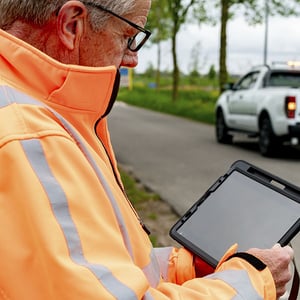
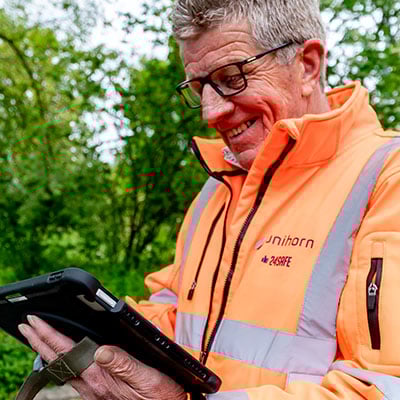
Inspech is used to assist inspectors in reviewing large volumes of road video data more efficiently and consistently, without replacing professional judgment or shifting responsibility.
This page explains what AI does within Inspech, what it does not do, and how control remains with the inspector at every step.
Why AI is used in road inspections
Road inspections increasingly involve large amounts of visual data.
Reviewing long stretches of footage manually is time-consuming and repetitive. It also increases the risk of inconsistency when inspection volumes grow or when multiple inspectors are involved.
AI is used in Inspech to support inspectors with this repetitive work, not to automate decisions, but to improve focus, consistency, and overview.
What AI does in Inspech
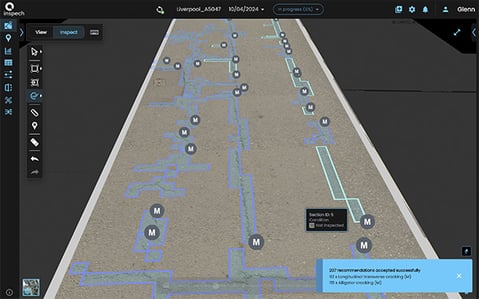
Within Inspech, AI is used to analyse road video data and highlight visual patterns that may indicate surface defects or irregularities..
- Scanning large volumes of footage
- Identifying potential areas of interest
- Suggesting classifications based on visual patterns
- Helping inspectors maintain consistent attention across long road sections
These outputs are presented as recommendations.
AI assists.
It does not assess.

What AI does not do
To avoid misunderstanding, it is important to be explicit.
Within Inspech, AI does not:
- Make final inspection decisions
- Replace inspectors
- Determine severity or priority autonomously
- Apply hidden or irreversible logic
- Operate without human review
Every inspection outcome remains the result of human judgment.
Human-in-the-loop by design
Inspech is built around a human-in-the-loop approach.
This means:
- AI suggestions are always visible
- Inspectors review, validate, adjust, or reject them
- No inspection result is final without human confirmation
The inspector remains accountable for the assessment,
supported by the system, not overruled by it.
This design principle is not optional.
It is foundational.
Transparency and explainability
Inspection results must be explainable.
Inspech ensures that:
- AI-assisted findings can be reviewed afterward
- Inspection decisions remain traceable
- It is clear which findings were supported by AI and which were confirmed by inspectors
This transparency supports internal review, quality assurance, and accountability toward clients and stakeholders.
Why this matters for responsible inspections
AI can increase efficiency, but only when applied carefully.
In professional inspection environments, uncontrolled automation introduces risk — not reliability. Inspech deliberately avoids black-box behaviour and autonomous decision-making.
By keeping AI supportive and inspectors in control, the system helps teams scale inspection capacity while maintaining professional standards.

SERVICE VIDEO
Showcase your awesome service with quality video content.
Lorem ipsum dolor sit amet, consetetur sadipscing elitr, sed diam nonumy
27K | 1.2MIO |
| Lorem ipsum dolor sit amet, consetetur sadipscing elitr, sed diam sit amet, consetetur elitr. | Lorem ipsum dolor sit amet, consetetur sadipscing elitr, sed diam sit amet, consetetur elitr. |

A realistic view on limitations
AI is a tool, not an authority. Its performance depends on:
- Data quality
- Context
- Review by experienced inspectors
Inspech is designed with these limitations in mind. That is why AI is used to assist, not to decide.
Frequently asked questions
The next step
If you want to discuss how AI is applied responsibly within your inspection process, you can request a demo or have a conversation with the team.
No assumptions.
Just clarity.