
<img alt="" src="https://secure.intelligentdatawisdom.com/782514.png" style="display:none;">
Skip to content
inspech_header_bdemorequest

For Organisations & Municipalities

Managing road inspections comes with responsibility.

Inspection outcomes influence maintenance decisions, budgets, safety measures, and accountability toward citizens, clients, and regulators. At the same time, inspection volumes increase while capacity, time, and consistency remain under pressure.

For organisations and municipalities, the challenge is not only to inspect more — but to do so in a way that remains reliable, explainable, and defensible.

The organisational challenge behind road inspections

At an organisational level, road inspections are about more than operational execution.

They involve:

 >   Consistency across inspectors and projects
 >   Traceability of inspection results
 >   Accountability for decisions based on inspection data
 >   Confidence that outcomes can be explained afterward

When inspections scale without sufficient structure, risk increases. Not because inspectors lack expertise, but because processes become harder to oversee and align.

Road Inspection Governments

SCHEDULE A MEETING WITH AN EXPERT

Why structure matters at scale

As inspection networks grow, informal processes start to show limits.

Differences in interpretation, documentation, and review can lead to:

 >   Inconsistent inspection outcomes
 >   Discussion about results rather than decisions
 >   Rework and additional site visits
 >   Difficulty justifying maintenance priorities

Structured support does not remove responsibility.
It helps organisations manage it.
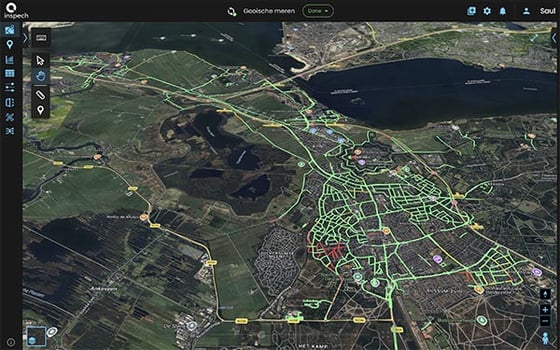
 

Road Inspection Networks


How Inspech supports organisational responsibility

Inspech is designed to support inspection organisations and municipalities in scaling inspection capacity without losing control.
The system supports this by providing these three promises.

1
Consistency across inspections

AI-assisted detection helps apply the same recognition logic across large datasets, while inspector validation ensures that professional judgment remains central.

This combination supports alignment across teams without forcing rigid automation.

2
Traceable and reviewable results

Inspection findings within Inspech remain structured and transparent.

This makes it possible to:

Review how conclusions were reached
> Trace findings back to visual evidence
> Compare results across time and projects

This traceability supports internal review and external accountability..


3
Explainable use of AI

Inspech avoids black-box decision-making.

AI outputs are visible and always subject to human review. This makes it clear where AI assisted and where inspectors made final assessments. This is an important distinction for responsible governance.

bg-video-161758688

SERVICE VIDEO

Showcase your awesome service with quality video content.
Lorem ipsum dolor sit amet, consetetur sadipscing elitr, sed diam nonumy

27K

1.2MIO

Lorem ipsum dolor sit amet,
consetetur sadipscing elitr, sed
diam sit amet, consetetur elitr.
Lorem ipsum dolor sit amet,
consetetur sadipscing elitr, sed
diam sit amet, consetetur elitr.
team-small-07
Gene CernanAstronaut, Apollo 17
“When you head on out to the Moon, in very short order, and you get a chance to look back at the Earth, that horizon slowly curves around in upon himself, and all of sudden you're looking at something that is very strange, but yet is very, very familiar, because you're beginning to see the Earth evolve.”
team-full-02
Gene CernanAstronaut, Apollo 17
“When you head on out to the Moon, in very short order, and you get a chance to look back at the Earth, that horizon slowly curves around in upon himself, and all of sudden you're looking at something that is very strange, but yet is very, very familiar, because you're beginning to see the Earth evolve.”
team-small-05
Gene CernanAstronaut, Apollo 17
“When you head on out to the Moon, in very short order, and you get a chance to look back at the Earth, that horizon slowly curves around in upon himself, and all of sudden you're looking at something that is very strange, but yet is very, very familiar, because you're beginning to see the Earth evolve.”
team-full-03-1
Gene CernanAstronaut, Apollo 17
“When you head on out to the Moon, in very short order, and you get a chance to look back at the Earth, that horizon slowly curves around in upon himself, and all of sudden you're looking at something that is very strange, but yet is very, very familiar, because you're beginning to see the Earth evolve.”

Supporting defensible decision-making

Organisations are ultimately accountable for decisions based on inspection data.

Inspech does not make maintenance or policy decisions.
It ensures that the underlying inspection data is consistent, transparent, and reliable enough to support those decisions.

This reduces:

  • Internal discussion about inspection quality
  • Uncertainty when justifying actions
  • Risk when inspection outcomes are questioned
Road_Inspection_Environment

Designed for professional environments

Inspech is built for use in professional and public-sector contexts, where predictability and restraint matter.

That means:

 >    No autonomous decision-making
 >    No hidden logic
 >    No dependence on individual inspectors alone
 >    No forced changes to inspection standards

The system supports existing governance frameworks instead of introducing new uncertainty.

Typical organisational benefits

Organisations using Inspech often experience:

  • More consistent inspection outcomes
  • Improved alignment across inspection teams
  • Fewer follow-up questions and re-inspections
  • Clearer justification of inspection-based decisions

Not because decisions are automated, but because inspection processes are structured.

Who this approach is intended for

This approach is intended for:

  • Municipalities and road authorities
  • Inspection service providers
  • Infrastructure owners
  • Organisations responsible for large road networks

It is not designed for environments that require fully automated decisions without human oversight.

Frequently asked questions

Who is responsible for inspection outcomes? Inspectors remain responsible for assessments. Organisations remain accountable for decisions based on those assessments.
Is the use of AI transparent? Yes. AI-assisted findings are visible and reviewable.
Does Inspech reduce organisational risk? Inspech helps reduce operational and interpretational risk by improving consistency and traceability — without removing responsibility.
Can inspection results be audited? Yes. Inspection data and validation steps remain reviewable.

The next step


If you want to understand how Inspech fits within your organisational or municipal inspection responsibilities, you can request a demo or discuss your context with the team.

No pressure.
Just a clear conversation.
meet_our team