

Rijkswaterstaat · Unihorn · The Netherlands
Since 2021, Unihorn has used Inspech as a repeatable part of its operational inspection delivery on the Dutch national highway network. Approximately 20,000 lane-km of inspection data has been processed through the combined workflow, including recurring inspections of Rijkswaterstaat-managed roads. AI-assisted analysis and professional inspector validation create consistent, georeferenced road-condition evidence at national scale.
Background
Dutch road authorities work within a rigorous, standardised inspection and maintenance environment. The CROW road-management methodology calls for visible defects to be recognised, assessed and recorded consistently, and recommends recurring network-level inspection to follow condition over time. Technology must therefore support professional judgement, traceability, comparable information and repeatable delivery.
Rijkswaterstaat manages approximately 3,000 route-km, representing 5,878 carriageway-km of main national roads. Since 2021, Unihorn has used Inspech within its professional workflow across approximately 80% of this network. A cumulative volume of approximately 20,000 lane-km of inspection data has been processed to date, including recurring inspection cycles.
In this delivery model, Unihorn is the professional inspection provider and Inspech is the operational assessment platform. The Dutch national highway network provides the public road-authority context; subsequent engineering and maintenance decisions remain with the responsible authority teams.
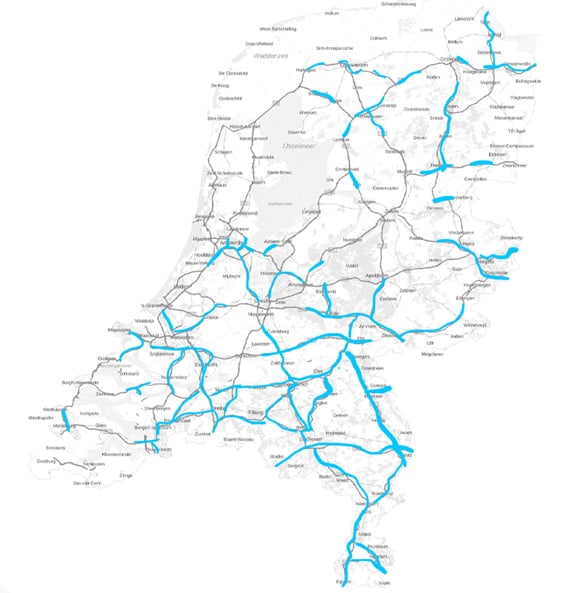
Blue lines indicate highways in the RWS network inspected by Unihorn with Inspech since 2021. Together, they represent approximately 80% of the Dutch national highway network. Coverage is cumulative; some routes have been inspected in more than one cycle.
The Challenge
National-scale inspection requires large volumes of road imagery to be reviewed efficiently and consistently without weakening professional control. Routes, inspection depth and reporting needs differ, while every visible finding must remain connected to its location, capture date and source evidence.
The requirement was therefore not simply automated detection. Unihorn needed a repeatable workflow that could increase review capacity, support consistent assessment across assignments and retain comparable evidence across inspection cycles. That continuity is essential for understanding what is changing in the network and deciding where closer attention is justified.
The Solution
Unihorn incorporated Inspech into its operational inspection workflow in 2021. Inspech organises compatible road imagery in a georeferenced environment and provides AI-assisted recommendations for visible surface defects. Unihorn's road inspectors review the imagery, validate or adjust the findings and interpret the result within the wider engineering context. Validated observations remain connected to route, location, imagery and inspection date.
This division of responsibility has remained central as the inspected area and historical evidence base have grown. AI accelerates and structures review; Unihorn's professionals own validation and interpretation. Road-authority, engineering and asset-management teams retain responsibility for subsequent investigation, maintenance planning and decisions.
The Operational Workflow
- Scope and capture: Agree the route, imagery requirements, inspection depth, assessment method and intended outputs before processing begins.
- Organise and georeference: Connect compatible imagery to the relevant route, location, capture date and inspection context.
- Conduct AI-assisted review: Use Inspech recommendations to work through large imagery volumes in a structured assessment environment.
- Validate professionally: Have Unihorn inspectors confirm, adjust or reject findings and retain control of classification and interpretation.
- Compare over time, report and hand over: Compare recurring inspections to identify visible change and use agreed reports or geodata outputs for prioritisation, targeted investigation and maintenance-planning support.
The Result
The client result is not coverage alone. The combined workflow creates a repeatable information layer in which each validated inspection can add to network visibility, historical continuity and better-founded next-step decisions.
Operational scale
Since 2021, the Unihorn-Inspech workflow has covered approximately 80% of the Dutch national highway network and processed a cumulative volume of approximately 20,000 lane-km of inspection data, including recurring inspection cycles. For context, Rijkswaterstaat manages approximately 3,000 route-km, representing 5,878 carriageway-km of main national roads. These are different measures: network length describes the managed footprint, while cumulative lane-km describes the inspection volume processed across lanes and cycles.
Consistency
Road imagery is reviewed in one structured environment using a defined assessment method and professional validation. This supports more consistent treatment across routes, assignments and dates, while inspectors remain responsible for confirming, adjusting or rejecting the AI-assisted recommendations.
Traceable network visibility
Validated findings remain connected to their georeferenced source imagery, route context, inspection date and professional review. This creates a defensible evidence trail and makes network-level information easier to review, explain and use alongside agreed reporting and geodata workflows.
Continuity over time
A single inspection provides a condition snapshot. Recurring inspections add comparable, time-stamped evidence layers. Comparing them helps show where visible conditions remain stable, where they are changing and where the network needs closer attention. The information base therefore becomes more valuable with each consistent inspection cycle.
Decision support
Comparisons over time are used to understand changes in the road network, prioritise sections for attention, target locations for more detailed engineering inspection and provide a stronger basis for the next step in optimising maintenance planning. The evidence supports these decisions; it does not replace engineering tests, professional judgement or authority responsibility.
INSTITUTIONAL VALUE Consistent information builds network visibility. Recurring comparison strengthens prioritisation and investigation. Repeated operational use creates durable capability for better-founded maintenance planning.
What This Demonstrates Internationally
The Netherlands provides a demanding reference environment: road inspection is standards-led, inspector competence is formally developed and condition evidence must support accountable asset-management decisions. Continued operational use since 2021, approximately 80% geographic coverage, approximately 20,000 lane-km of cumulative inspection data processed and the use of recurring inspections for comparison demonstrate that Inspech can be embedded in professional delivery at national-network scale.
Continued operational use over multiple years and assignments demonstrates that Inspech can operate within a mature, standards-driven inspection environment without transferring professional responsibility away from qualified inspectors. For authorities and inspection providers elsewhere, this is practical evidence that scalable AI assistance, local inspection expertise and accountable decision-making can coexist.
Lessons Learned
- The strongest network-management value compounds when inspections are repeated consistently and compared over time.
- Operational time and review-capacity benefits vary with inspection depth, classification requirements and validation effort; the enduring client value comes from consistent, recurring evidence that can be compared over time.
- Comparable results depend on consistent capture, assessment methods, route context and inspection dates.
- Institutional adoption requires clear roles: AI assists, inspectors validate and authorities decide.
- Visual condition evidence strengthens prioritisation and investigation but does not replace structural or functional testing.
Get your inspection process flowing
Use a representative route, compatible imagery, the applicable inspection method and your own professionals to validate how Inspech can create a recurring, comparable evidence layer between formal engineering surveys before scaling.