Skip to content

INSPECTION & ENGINEERING PROVIDERS

Inspect more road imagery without sacrificing professional judgement.

Inspech helps inspection and engineering providers organise road imagery, accelerate visual review with AI-assisted recommendations and deliver consistent, traceable results to their clients.

Inspectors remain in control, and Inspech fits alongside the engineering measurements and investigations already used in professional pavement assessment.

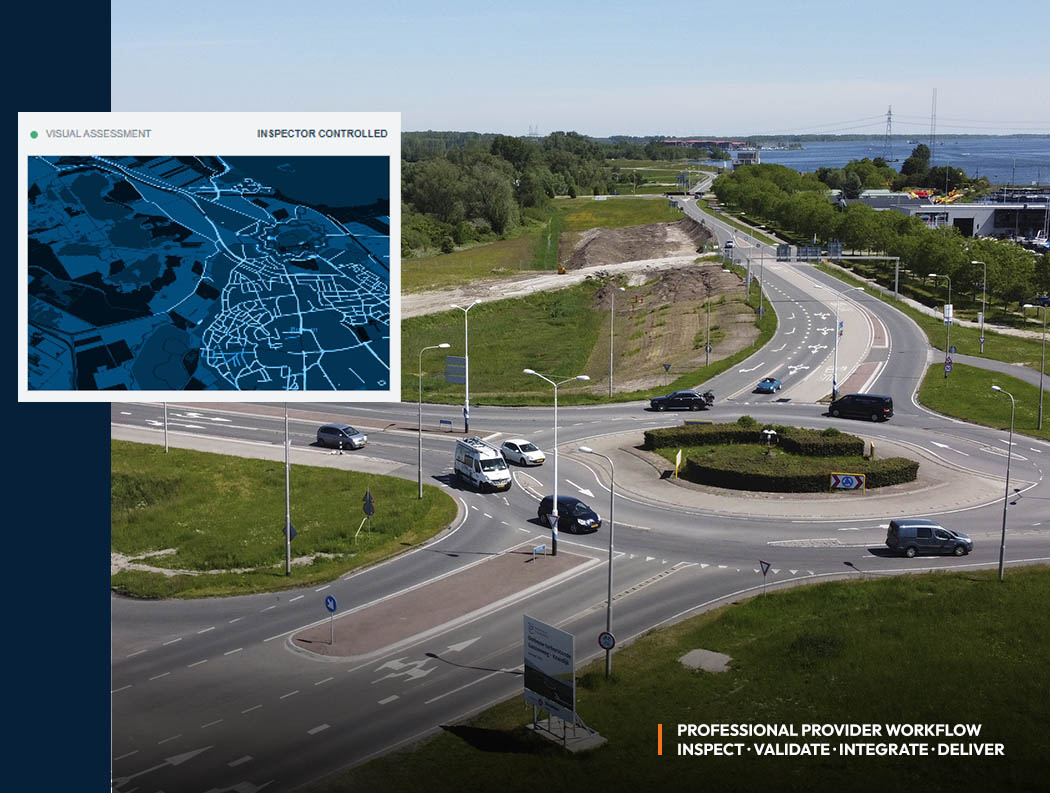
professional provider workflow

Built for professional delivery     |     Compatible imagery     .     Visible recommendations     .     Inspector validation     .     Traceable outputs     .     See the workflow

THE PROVIDER OPERATING REALITY

Scale the visual assessment step, not the responsibility around it.

Professional providers must balance project throughput with consistent quality, standards, transparent evidence and the wider engineering question. Visual review can become a bottleneck when imagery volumes grow.

Inspech gives teams a structured environment for assisted visual assessment. Inspectors review every recommendation, while engineers retain responsibility for measurements, interpretation and the advice delivered to the client.



operating-reality_ai

operating-reality1
operating-reality2
operating-reality-3
operating-reality-4

PROVIDER OUTCOMES

More capacity for professional, transparent delivery.

Operational value for inspection firms, engineering consultancies and pavement specialists—while keeping methods, validation and client responsibility with the provider.

provider-outcomes1provider-outcomes2provider-outcomes3provider-outcomes4provider-outcomes5


INSIDE THE INVESTIGATION CHAIN

One focused visual-assessment layer within a broader professional process.

Inspech does not become the measurement provider or replace pavement investigation. It helps providers make the imagery-review step more scalable, consistent and traceable.

investigation-chain1investigation-chain2investigation-chain3investigation-chain4investigation-chain5


Essential complementary work remains in place     |     Radar   ·   FWD   ·   Point cloud   ·   Drilling   ·   Laboratory analysis   ·   Pavement engineering   ·   Client advice


CLIENT DELIVERY

Make the visual evidence easier to review, explain and use.

Clients do not only need a conclusion. They need confidence in the route from evidence to professional advice. Inspech helps providers preserve that route through georeferenced imagery, visible findings and inspector validation.

client-delivery1client-delivery2client-delivery3


FEATURED PROVIDER EVIDENCE
Unihorn   ·   Independent research, consulting and design firm


provider evidence

UNIHORN WORKFLOW

Visual assessment working alongside a complete pavement investigation.

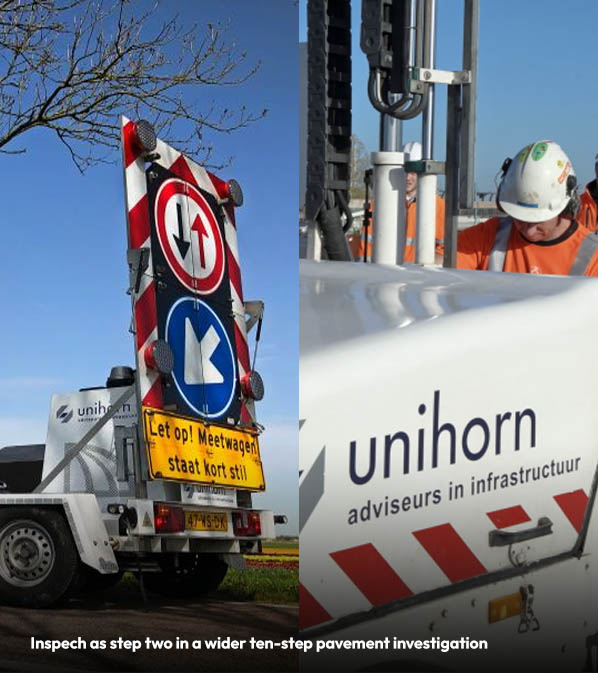
Unihorn uses Inspech early in its professional process: after road imagery is captured and before radar, FWD, point-cloud, drilling and laboratory work. Inspectors review and validate the visual assessment while the wider investigation remains under Unihorn’s professional direction.


Step 01 Data collection  →  Step 02 Inspech analysis  →  Steps 03–10 Investigation to execution


“With Inspech, we finally have the overview we always wanted, without losing human expertise.”
JEROEN BLEEKER · DIRECTOR UNIHORN

The approximately 80% figure is documented existing coverage. The 8,000 km and 20,000 lane-km figures describe the wider network context; projected national business-case benefits are not presented as realised RWS outcomes.


ADDITIONAL REGIONAL SCALE EVIDENCE

DTAP: more than 10,000 lane-km in the first operational year.

DTAP integrated Inspech into its delivery workflow while its pavement specialists retained validation, interpretation and client responsibility.

>10.000 lane-km  
Read the DTAP story  ↗  


OPERATIONAL VALIDATION

Validate Inspech within your public-road workflow.

Use a representative route, compatible imagery, your applicable inspection standard and your own professional inspectors to determine how Inspech fits your operating process.

AGREE SUCCESS CRITERIA BEFORE STARTING


✓     Workflow and imagery fit

✓     Processing effort and consistency

✓     Standards, outputs and systems

✓     Potential recurring cadence