
TRUST BY DESIGN
Road intelligence people can inspect, challenge and explain.
Inspech uses AI to assist professional visual road assessment—without transferring judgement or accountability to the technology.
Recommendations remain visible. Inspectors validate every result. Data, access and operating arrangements are defined for the workflow in which Inspech is used.
Four operating principles | Professional control . Reviewable evidence . Defined data governance . Validated operational fit
RESPONSIBLE AI IN PRACTICE
Clear boundaries create trustworthy workflows.
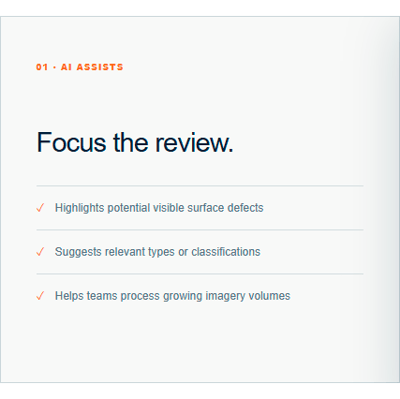
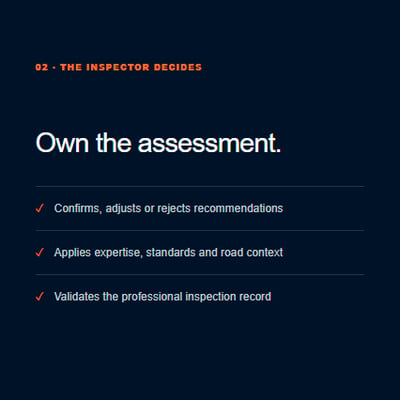
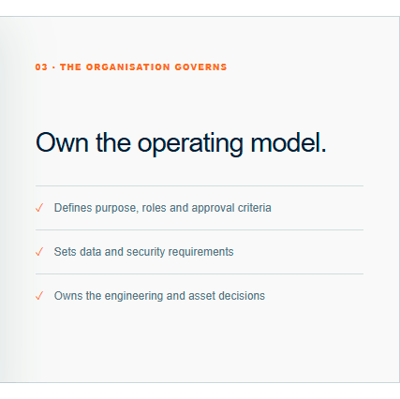
Responsible use starts by making the division of work explicit. The technology assists; professionals interpret; the organisation governs.
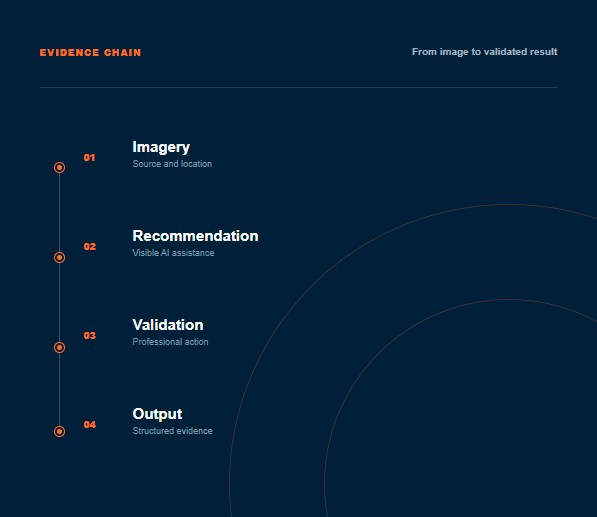
TRACEABILITY
Keep the evidence, context and professional action connected.
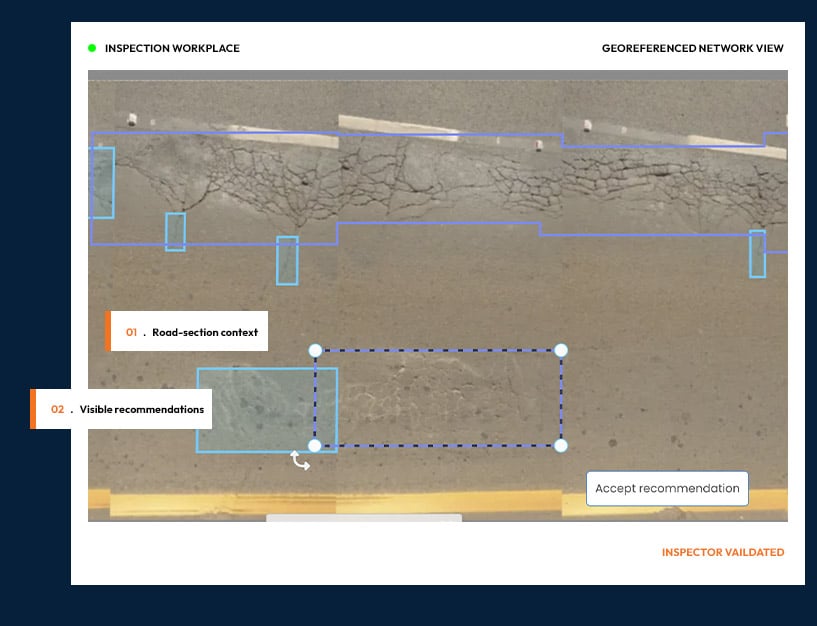
Trust does not come from an AI answer alone. It comes from a reviewable chain that links what was visible on the road to the recommendation, the inspector's action and the structured result.
01 Georeferenced context
Findings remain connected to route, road section and source imagery.
02 Visible recommendations
AI assistance is presented for review rather than hidden behind a final score.
03 Validated records
Professional confirmation and the resulting assessment can be revisited.
SECURITY AND DATA GOVERNANCE
Define the operating conditions before the workflow scales.
Security is part of operational fit. The appropriate arrangements depend on the organisation, information scope and delivery context, and should be agreed explicitly.
01
Data scope
Define which imagery, location information, inspection records and outputs are required for the agreed purpose.
02
Access and roles
Agree who can upload, review, validate, export and administer information within the operating workflow.
03
Hosting and processing
Confirm the applicable delivery, processing and organisational requirements before operational use.
04
Retention and exit
Align retention, export and end-of-engagement arrangements with the organisation's governance requirements.
EVIDENCE-LED ASSURANCE | Requirements, responsibilities and controls should be confirmed for the intended deployment. Inspech does not use generic certification claims as a substitute for that conversation.
RESPONSIBLE AI CONTROLS
Six principles for professional use.
These principles guide how Inspech is positioned, configured, validated and used within real inspection workflows.
01
Human oversight
Professional inspectors confirm, adjust or reject recommendations before they become part of a validated assessment.
02
Reviewability
Recommendations remain visible in their road, image and section context so the basis of an assessment can be reviewed.
03
Purpose limitation
AI assistance is applied to a defined visual inspection objective, not treated as a general engineering conclusion.
04
Relevant inputs
Imagery quality, positioning, capture configuration and the applicable assessment method are validated for the intended workflow.
05
Clear accountability
Inspech assists the review. Inspectors own the assessment. Engineers and asset managers own the decisions that follow.
06
Operational validation
Fit is tested with representative imagery, criteria and inspectors before a workflow is expanded.
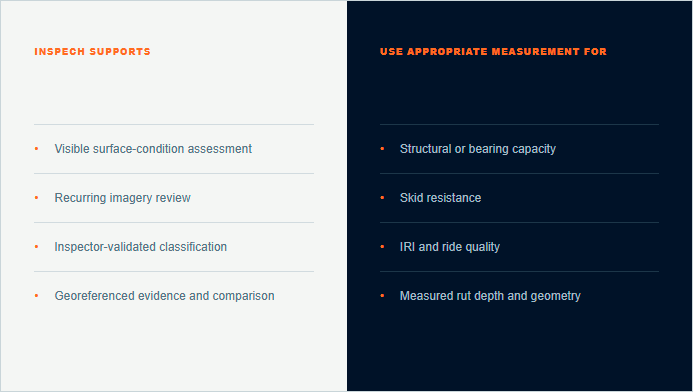
KNOW THE BOUNDARY
Visual intelligence is one part of the engineering picture.
Inspech strengthens recurring visual assessment. It does not convert imagery into conclusions that require physical, geometric or structural measurement.
FREQUENTLY ASKED QUESTIONS
What governance and decision-makers usually ask.
The exact technical, contractual and organisational arrangements are confirmed for the intended operating context.
VALIDATE BEFORE YOU SCALE
Test trust, control and operational fit in your own workflow.
Use representative imagery, your applicable method, your inspectors and agreed governance criteria to determine whether Inspech is the right next step.
INCLUDE IN THE VALIDATION
✓ AI recommendation and validation roles
✓ Evidence and traceability requirements
✓ Data scope, access and operating conditions
✓ Standards, outputs and system fit
✓ Go, adjust or stop decision criteria